September 2, 2026
Roeslein & Associates has launched the R.U.D.I. AI Vision Camera, a real-time monitoring system that gives can manufacturers visibility into a part of the production line that has never been measurable before: the movement of cans between key process stages, such as the infeed and discharge of the washer. Built on Roeslein’s existing R.U.D.I. AI platform, the Vision Camera uses computer vision to count upright and fallen cans as they move through the line, flagging spoilage trends the moment they happen rather than after the fact. It can be retrofitted onto new or existing lines, making it one of the first tools purpose-built to solve canmaking’s long-standing “invisible spoilage” problem between the bodymaker and decorator.
A new vision system gives can manufacturers real-time counts of upright and fallen cans at points along the production line that were previously impossible to monitor, helping cut spoilage and improve efficiency.
Roeslein & Associates has introduced the R.U.D.I. AI Vision Camera, a new innovative product within its R.U.D.I. AI platform.
The Vision Camera is based on Roeslein’s broader AI platform, which for the past several years has been focused on data management and predictive maintenance. The Vision Camera represents the platform’s entry into real-time visual monitoring, with further AI-powered capabilities planned as the platform develops.
For canmaking, the system is designed to accurately count both upright and fallen cans in real time. Because it can be fitted onto either new or existing production lines, R.U.D.I. AI Vision gives can manufacturers visibility into a part of the process that has previously remained unmeasured: the movement of cans between major process stages, for example between the infeed and discharge of the washer.
The acronym R.U.D.I. stands for “Roeslein’s Unified Data Intelligence” and is also a nod to the company’s founder, Rudi Roeslein.
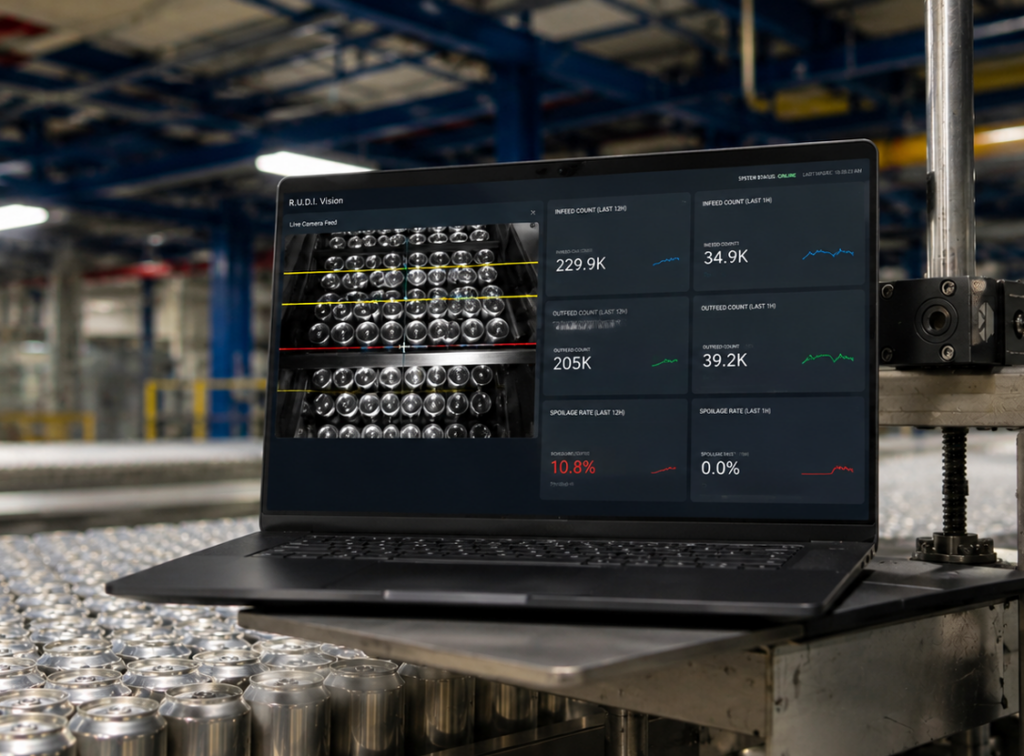
Improving Accuracy in Canmaking
In the canmaking process, spoilage between the bodymaker and the decorator is one of the major sources of loss, although, up to now, it has also been one of the least noticeable. Operators have never had a clear understanding of how much product is being lost at that stage or where the losses occur. R.U.D.I. AI Vision eliminates this lack of visibility by employing AI models that, based on camera input, track and count cans as either good or fallen in real time and trigger alarms when spoilage trends exceed a predetermined threshold.
“Operators will have visibility over a part of the process they previously had no information about,” said Sam Richards, Director of Systems Engineering at Roeslein & Associates. “The system doesn’t simply indicate that a spoilage problem exists; it shows exactly where the problem is and enables it to be detected as it’s occurring, rather than only after a considerable delay.”
A System Built to Fit Around the Line
R.U.D.I. AI Vision is usually installed on either side of the washer, covering both the infeed and discharge sections, since these are among the areas in can manufacturing where spoilage is highest and visibility is lowest. It can, however, be placed anywhere in the plant where more accurate counts are required.
The system is available as a self-contained frame that sits over the conveyor, allowing it to be fitted onto existing lines without new equipment or a large-scale installation. It is designed for plug-and-play use, so plants can add it to an existing line rather than build around it.
Data That Goes Beyond the Camera
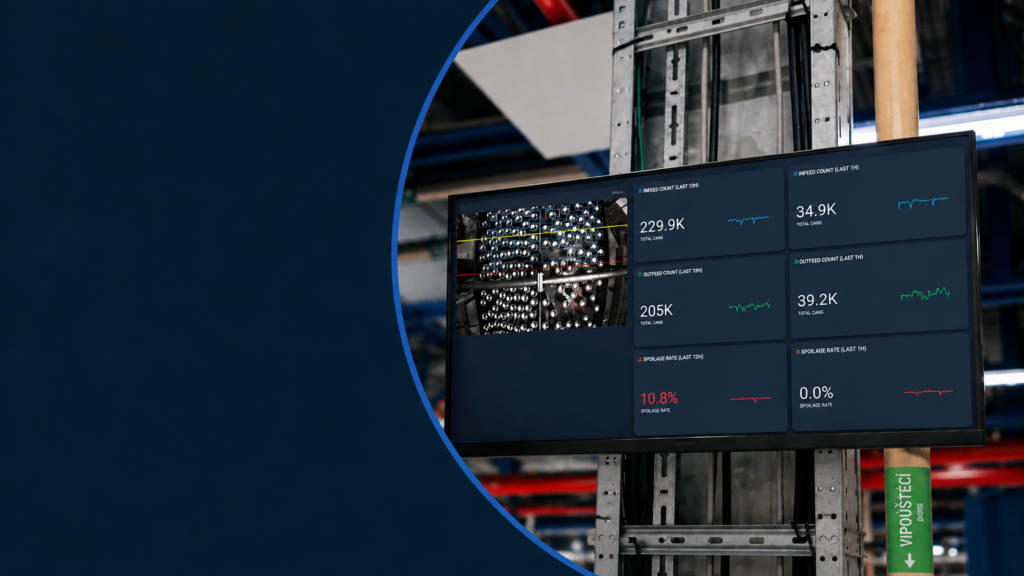
Beyond detecting issues, R.U.D.I. AI Vision is designed to enhance overall awareness of what is happening across the production line. Data can be accessed through a web-based dashboard and is also sent to MES and SCADA systems, giving plants historical tracking and trend information rather than just a current count. Alarms and thresholds can be configured to automatically alert operators when spoilage trends exceed acceptable levels.
The system is also built to scale, from a single camera on one line to multi-camera, enterprise-grade arrangements that combine multiple cameras and multiple plants into a single central display. R.U.D.I. AI Vision is offered in a range of configurations, from a basic single-camera setup to multi-camera systems for longer conveyors, so the solution can be tailored to a line’s specific layout and requirements.
“We built this so R.U.D.I. can be dropped onto a line as a self-contained unit, frames, brackets, cables and all, rather than something that requires a new line or a major install project,” added JC Harrison, Partner and Vice President of Systems and Operational Services at Roeslein & Associates. “R.U.D.I. AI was never intended to limit itself to a single application. Although vision is the most recent addition, the concept is to continue building and linking together cameras, data, and predictive tools, so customers get a view of their entire operation and not just one production line.”
Roeslein is currently working with early-adopter customers to refine and standardise the R.U.D.I. AI Vision system ahead of a wider rollout, with strong interest already emerging from the sector.
ENDS.
FAQ:
What is the R.U.D.I. AI Vision Camera?
A real-time monitoring system from Roeslein & Associates that counts upright and fallen cans at points on the production line that were previously impossible to track, helping manufacturers catch spoilage as it happens.
Where is R.U.D.I. AI Vision typically installed?
Most commonly on either side of the washer, covering both infeed and discharge, since that’s where canmaking spoilage tends to be highest and visibility lowest. It can also be positioned anywhere on the line where more accurate counts are needed.
Can it be added to an existing production line?
Yes. It’s built as a self-contained frame that sits over the conveyor, so it can be retrofitted without new equipment or a major installation project.
What does R.U.D.I. stand for?
Roeslein’s Unified Data Intelligence — also a nod to the company’s founder, Rudi Roeslein.
How does the data get used?
It’s available through a web-based dashboard and also feeds into MES and SCADA systems, giving plants historical tracking and trend data, not just a live count, with configurable alarms for when spoilage exceeds set thresholds.
